
AP inbox automation for NetSuite is one of the clearest efficiency wins available to a finance team, and one of the easiest to get wrong. This guide explains how to automate an accounts payable or orders inbox with agentic AI in a way that stays controlled and auditable, rather than simply faster. It is written for CFOs, financial controllers and finance transformation leads who run NetSuite and want the benefits of automation without giving up oversight.
The approach described here is the one behind Workflow Autopilot, Fowlers Consulting’s application for controlled inbox automation in NetSuite. The principles hold whatever you build with, though: a trustworthy automation has to check, act, review and record, in that order.
The shared AP and orders inbox nobody controls
Every finance and operations team has at least one inbox that runs by whoever gets there first. The AP inbox. The orders inbox. The supplier queries inbox. Emails arrive, someone reads them, and something manual happens. Numbers get copied into a spreadsheet. A bill gets keyed into NetSuite. An approval gets chased over Teams. If the person who normally handles this is off, the email waits.
The process works after a fashion. Bills get paid. Orders get confirmed. But it is fragile in ways that only become visible when something goes wrong. There is no audit trail. Errors come from transcription, not from bad decisions. Consistency depends entirely on who handled the email that day, and how much else was happening when they did it.
What good AP inbox automation actually has to get right
Before choosing any tool, it helps to be clear about what you are asking the automation to do. Genuine AP inbox automation for NetSuite has to:
- understand what each email is actually asking for, not just extract text from it;
- validate the details against NetSuite — the purchase order, the supplier record, the customer, the product codes;
- apply your own policies, including approval limits and coding rules;
- keep a human in the loop wherever the action carries real risk;
- handle exceptions openly rather than guessing; and
- leave a complete, timestamped record of what happened and why.
Most of the disappointment with AP automation comes from tools that do the first one or two of these and quietly skip the rest.
Why a single AI action is not enough
The instinct is to point an AI at the inbox and have it take actions. Extract the invoice, create the bill, send the confirmation. That sounds like automation, and in a narrow sense it is. But a single-step AI approach introduces its own risks.
The agent cannot tell a legitimate supplier invoice from a fraudulent one unless you specifically test for that. It has no independent check on whether it followed your documented procedure. It takes an action and moves on. If it got something wrong, you find out later, when it matters.
There is a second problem, too. A single-step agent cannot tell you, after the fact, whether it deviated from policy, because it never reviews its own work. That limitation holds regardless of how capable the underlying model is. Speed without control is not progress. It is just faster mistakes.
Agentic AI vs RPA vs a chatbot
It is worth being precise about what an agentic approach is, and what it is not. These three things are often lumped together, and they behave very differently in an accounts payable setting.
| Approach | How it works | Where it struggles |
|---|---|---|
| Chatbot / assistant | Answers questions and drafts text when a person asks. It waits to be prompted and leaves the action to you. | No control over what happens next, nothing is validated against NetSuite, and there is no audit trail of business actions. Useful for drafting replies, not for running a process. |
| RPA (robotic process automation) | Follows scripted rules and clicks through screens exactly as coded. | Breaks on variation. A new invoice layout or an unexpected field stops the bot, and the rules must be re-coded whenever a process changes. |
| Agentic AI (this approach) | Reads the email in context, validates it against NetSuite, applies your documented procedures, and flags what it cannot confidently handle. | Needs a documented procedure to codify, and human approval on sensitive actions. In return it copes with the variation a real inbox produces. |
Workflow Autopilot sits firmly in the third category. It is not a chatbot: it does not sit and wait to be asked. It is not RPA: it does not fail the moment a supplier changes a PDF layout. It runs a real operational process, from a specific inbox, with clear steps and reviewable outputs.
How the agentic AP pipeline works
Workflow Autopilot processes each incoming email through three sequential agent steps before any action reaches your systems or your approvers. A human approval step then sits on top for anything sensitive.
Step 1: Security and intent check. Before anything else, the agent assesses the email. Is this a legitimate business communication? Is it a request the system should act on, or something that should be routed to a human without action? The agent checks for indicators of phishing, social engineering, and requests that fall outside the expected scope of the inbox. Suspicious or ambiguous emails are flagged rather than processed. This is where the first line of invoice fraud detection sits.
Step 2: Process and action. Once an email clears the first step, the agent gets to work. It extracts the relevant data — invoice fields, purchase order lines, customer details — validates those against NetSuite, and produces a structured business object: a proposed bill, a draft sales order, a suggested reply. This is not a free-form summary. It is a reviewable record with defined fields that can be edited, approved, or rejected.
Step 3: Policy compliance check. A second agent then reviews what the first agent did. Did it extract the correct fields? Did it apply the right coding? Did it flag the discrepancies it should have flagged? This step is specifically designed to catch cases where the processing agent acted outside your documented procedure, before that output reaches a human or posts to any system.
Step 4: Human approval, where it matters. For sensitive actions — posting a bill, confirming a sales order — the processed artefact goes to an operator for review and explicit sign-off before anything touches NetSuite. For these action types, approval is a structural requirement rather than a convenience. For lower-risk actions, the workflow can be configured to proceed automatically once the three checks are clear. This is human-in-the-loop AI for accounts payable done deliberately: the machine does the preparation, a person keeps the authority.
The result is not just a faster inbox. It is a process that runs the same way every time, catches the categories of failure that matter most, and leaves a complete record of what happened at each step.
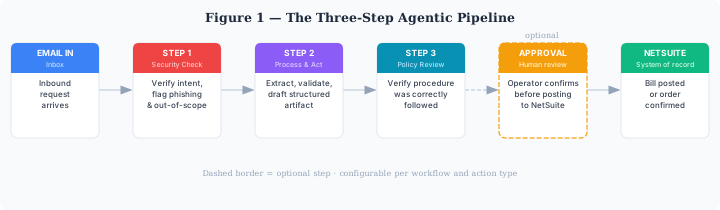
Each email passes through three sequential agent steps, with human approval on top for sensitive actions, before anything reaches NetSuite.
What each step checks and produces
The table below summarises what each stage of the pipeline does and, just as importantly, what it is there to prevent.
| Step | What it does | What it prevents |
|---|---|---|
| Step 1 — Security & intent | Assesses every email before any action is taken. Checks for phishing indicators, social-engineering attempts and requests outside the expected scope of the inbox. Flags rather than processes anything suspicious or ambiguous. | Malicious emails actioned automatically; fraudulent invoices processed as legitimate; staff targeted via the supplier inbox; out-of-scope requests confirmed without review. |
| Step 2 — Process & action | Extracts the relevant data from the email, validates it against NetSuite (purchase orders, customer records, product codes) and produces a structured artefact: a proposed bill, draft sales order or similar reviewable record. | Manual transcription errors; inconsistent field extraction between operators; operators starting from a blank screen; PO matching done by hand every time. |
| Step 3 — Policy review | A second agent reviews what Step 2 produced, field by field, against your documented procedure. Checks coding, matching logic, flagging rules and whether discrepancies were correctly identified. Runs before the artefact reaches any operator or your ERP. | The processing agent acting outside policy; coding or matching errors reaching approvers; discrepancies missed before sign-off; no independent check on AI output. |
| Human approval (sensitive actions) | An operator reviews the artefact and gives explicit sign-off before NetSuite is updated. Configurable per workflow type. | Unauthorised postings to your ERP; no accountability trail from email to confirmed record. |
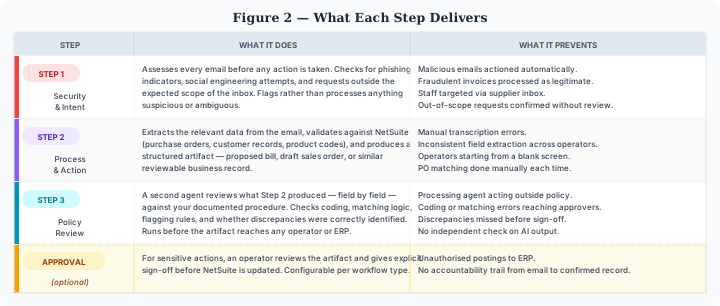
Each step targets a specific category of failure. Together they give you a process you can rely on and audit.
AP bill processing in NetSuite: a worked example
Consider accounts payable. A supplier sends an invoice to your AP inbox.
Step 1 checks the sender, the content structure and the request type. It is a legitimate invoice from a known supplier. It passes.
Step 2 extracts the invoice fields, matches them to an open purchase order in NetSuite, checks whether the amounts are within tolerance, and drafts a proposed bill. If there is no matching PO, or if the amounts are outside tolerance, it flags the discrepancy rather than proceeding.
Step 3 reviews the extraction and the matching logic. Did the agent capture the correct invoice number? Did it apply the right VAT treatment against the details a valid UK VAT invoice must show? Did it correctly identify the discrepancy? If everything checks out, the artefact goes to an approver.
The approver sees the original email, the extracted invoice data, the matched PO, the proposed bill, and a summary of any issues. They approve it or send it back with a note. On approval, the bill posts to NetSuite. The full sequence — email receipt, three agent steps, approval decision — is logged with timestamps.
Clean AP data posted this way also makes downstream reconciliation easier. It is the same discipline we apply to reconciling GRNI in NetSuite: capture the detail correctly at source, and the month-end position is far less painful.
What this removes from your team’s workload: manual field transcription, the effort of pulling up the PO to compare, the back-and-forth of chasing approvals by email, and the gap in the audit trail between receiving an invoice and posting the bill.
From email to sales order in NetSuite
The same pipeline applies to inbound customer purchase orders, turning an email into a sales order in NetSuite without manual re-keying. A customer sends a PO by email. Step 1 checks it is a genuine order from a known contact. Step 2 extracts the order lines, validates product codes and pricing against NetSuite, and drafts a sales order. Step 3 reviews the draft for completeness and policy compliance — correct pricing tier applied, MOQ rules observed, credit status checked.
The draft sales order goes to an operator for confirmation before NetSuite is updated. For standard orders from regular customers, the three steps and the approval take minutes rather than the manual equivalent. For complex orders with unusual terms, the operator gets a pre-built draft to review rather than starting from scratch.
For distributors, this pairs naturally with NetSuite credit hold automation, so an order can be captured, checked against credit status and released to the warehouse under consistent rules.
The audit trail behind every action
The part finance leaders tend to value most is not the speed — it is the record. Every email, every agent step, every flag and every approval decision is captured with a timestamp. When an auditor, an FD or a board member asks why a particular bill was posted, the answer is a complete accounts payable audit trail rather than a memory of who did what.
That record also feeds cleanly into period-end. A well-controlled inbox means fewer surprises when you work through your NetSuite month-end close checklist, and it supports proper balance sheet sign-off with a full audit trail in MatchPoint.
Consistency at scale
The value of the pipeline becomes clearer at volume. If your team handles thirty AP invoices a week manually, the quality of that work varies depending on who is at their desk and how much else is happening. The agent handles each one the same way. Step 1 runs the same checks on every email. Step 2 applies the same extraction and validation logic. Step 3 asks the same review questions.
Exceptions are handled explicitly rather than quietly. When the agent cannot match a PO or flags a suspicious sender, that appears in the audit log as a deliberate decision point, not a gap. Over time, you can see exactly what kinds of exceptions your inbox generates and whether your procedures are handling them well.
This is what makes inbox automation useful rather than just fast. A shared inbox where everyone does their best is hard to measure and harder to improve. A pipeline with explicit steps and a complete log is a process you can understand, audit and change.
Where human judgement is still required
None of this removes the need for people. It changes what they spend their time on. The agent is deliberately built to stop and ask rather than to guess. Unusual supplier terms, a first invoice from a new vendor, an order that breaches a credit limit, anything that looks like fraud — these are surfaced for a person to decide, not resolved silently.
The honest position is that AI is very good at the repetitive, checkable parts of AP and order processing, and people remain better at judgement calls, relationships and genuine exceptions. A good automation makes that division of labour explicit rather than pretending the judgement has gone away.
Bringing this to your NetSuite environment
Workflow Autopilot works best when there is a real procedure to codify, even if that procedure currently lives only in one person’s head. If you have a workflow that runs through a shared inbox, involves keying data into NetSuite, has approval steps happening informally over email or chat, and produces no reliable audit trail, this is the problem it was built for.
It sits alongside the rest of our work: the same agentic techniques behind agentic AI for the NetSuite catalogue, delivered under our NetSuite automation services and available with the rest of our NetSuite products. As a member of the Anthropic Partner Programme, we build these agents on frontier models with the controls finance teams need.
Fowlers Consulting Services Ltd are an AI-first NetSuite consultancy based in the UK. If you would like to talk through whether your AP or orders inbox is a fit for agentic automation, book a NetSuite automation conversation.
Frequently asked questions
What is AP inbox automation for NetSuite?
It is the use of software to process the emails that arrive in an accounts payable or orders inbox — supplier invoices, customer purchase orders and related requests — and turn them into validated records in NetSuite. A controlled approach reads each email, checks it against NetSuite, applies your policies and routes anything sensitive to a person for approval.
How is agentic AI different from RPA for accounts payable?
RPA follows scripted rules and breaks when an invoice layout or a process changes. Agentic AI reads the request in context, validates it against NetSuite and flags what it cannot confidently handle, so it copes with the variation a real supplier inbox produces.
Does the AI post invoices to NetSuite automatically?
For sensitive actions such as posting a bill or confirming a sales order, no. The processed artefact goes to an operator for explicit sign-off before anything is written to NetSuite. Lower-risk actions can be configured to proceed automatically once the automated checks are clear.
How does it handle UK VAT checks on supplier invoices?
During processing, the agent checks the VAT treatment on the invoice as part of validating the record, and the policy-review step confirms it before the bill reaches an approver. The approver still sees the figures and signs off, so VAT treatment is checked by the system and confirmed by a person.
Can it detect fraudulent or suspicious invoices?
The first step assesses every email for phishing indicators, social-engineering attempts and requests outside the inbox’s normal scope, and flags anything suspicious for a human rather than processing it. It reduces the risk of a fraudulent invoice being actioned automatically; it does not replace your wider fraud controls.
What audit trail does it leave?
Every email, agent step, flag and approval decision is recorded with a timestamp, giving a complete trail from the moment an email arrives to the confirmed record in NetSuite.
Can it process customer sales orders as well as supplier invoices?
Yes. The same pipeline turns an inbound customer PO into a draft sales order in NetSuite, validating product codes, pricing tier, MOQ rules and credit status before an operator confirms it.