
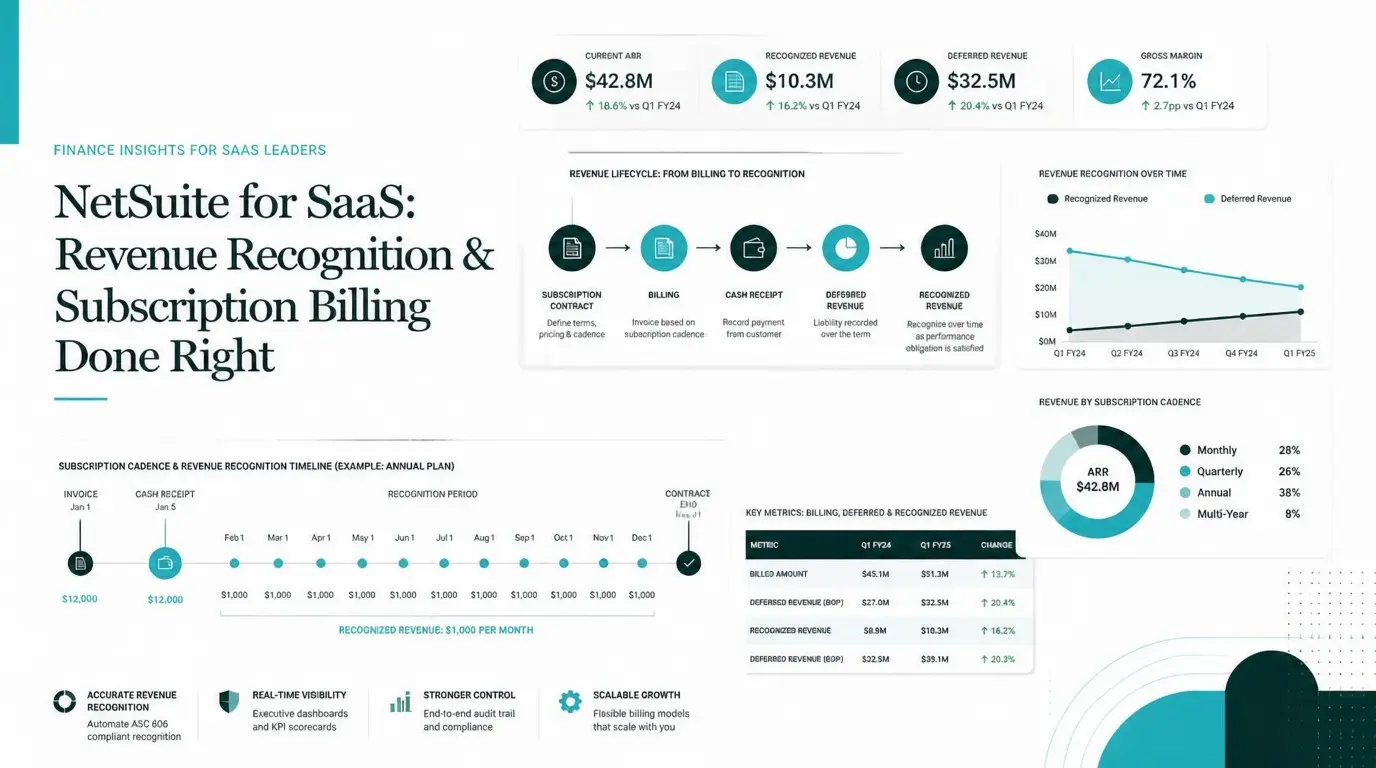
SaaS finance appears straightforward externally but presents genuine complexity. The amount you invoice customers differs substantially from the revenue you’re permitted to recognize under accounting standards, while cash collection follows its own timeline entirely. Managing these three separate schedules within a generic accounting system forces finance teams to rebuild critical functionality through spreadsheets.
Why SaaS finance breaks generic accounting systems
The fundamental challenge stems from misaligned timelines:
- Billing – invoicing a customer £12,000 for an annual contract upfront
- Cash – receiving the £12,000 (potentially in installments or delayed)
- Revenue – recognizing only £1,000 monthly as service is delivered, with £11,000 remaining as deferred revenue liability until earned
Generic systems lack native understanding of this third timeline. Finance teams consequently maintain separate spreadsheets for deferred-revenue schedules, reconciliation records, and ARR/MRR calculations. Contract modifications necessitate manual updates across all supporting documents, creating bottlenecks that intensify as businesses scale.
Revenue recognition in NetSuite (ASC 606 / IFRS 15)
NetSuite incorporates native revenue-recognition capabilities aligned with current accounting standards, automating recognition through system rules rather than manual spreadsheet processes.
Performance obligations & rev-rec rules
ASC 606 and IFRS 15 require recognizing revenue as you fulfill distinct performance obligations, the specific promises within a contract. A typical SaaS arrangement contains multiple obligations: the subscription itself, implementation fees, professional services, or hardware components. Each obligation carries its own recognition treatment.
NetSuite enables defining recognition rules once and attaching them to line items, automatically splitting multi-element contracts across their respective obligations with appropriate recognition bases.
Deferred revenue schedules
Advance billing triggers automatic deferred-revenue liability posting and recognition schedule generation in NetSuite. The system releases liability to the P&L automatically throughout the service period, eliminating manual schedule maintenance and release journals. The deferred-revenue balance reconciles directly to underlying contracts, precisely what auditors require.
Subscription billing with SuiteBilling
Revenue recognition addresses one SaaS challenge; executing the billing itself represents the complementary problem. NetSuite’s SuiteBilling module natively supports recurring, usage-based, and hybrid billing structures.
Recurring invoicing
Subscriptions are configured once (including term, price, billing frequency, and renewal terms) and SuiteBilling generates scheduled recurring invoices that flow directly into the revenue-recognition engine, maintaining alignment rather than requiring post-facto reconciliation.
Upgrades, downgrades & proration
Mid-contract modifications exemplify where manual processes collapse. Customer upgrades, seat additions, downgrades, or churn mid-period require repricing, prorating differences, adjusting billing, and recalculating deferred-revenue schedules. SuiteBilling manages prorations and billing adjustments while linked revenue schedules automatically recalculate, transforming complex changes into straightforward configuration updates.
The metrics investors want: ARR, MRR, churn
SaaS businesses operate beyond statutory reporting, depending on investor-tracked metrics: annual and monthly recurring revenue, net revenue retention, churn, bookings, and billings. Most developing SaaS finance organizations derive these metrics manually through monthly spreadsheets, creating production delays and reliability concerns.
Properly structured subscriptions and recognition within NetSuite preserve underlying metric data within the system, accessible through dashboards and reporting rather than monthly reconstruction. This dual benefit delivers: investor materials become ledger byproducts rather than separate exercises, and operating metrics reconcile to statutory numbers.
Common SaaS NetSuite setup mistakes
NetSuite performs effectively for subscription businesses, but requires appropriate configuration. Recurring implementation issues include:
- Items lacking recognition rules, requiring manual journals despite platform automation capabilities
- Bundled contracts not separated into performance obligations, resulting in incorrect recognition
- SuiteBilling and revenue recognition operating independently, causing billing changes to diverge from revenue schedules
- ARR/MRR definitions inconsistent with statutory numbers, creating narrative conflicts
- Unoperationalized close procedures, leaving deferred-revenue reconciliation and revenue-recognition reviews manual
These represent configuration rather than platform limitations, all are addressable.
How Fowlers implements NetSuite for SaaS businesses
Fowlers structures NetSuite implementations for UK SaaS businesses with subscriptions as the central architectural element: recognition rules reflecting actual contracting practices, SuiteBilling ensuring billing-revenue alignment, automated deferred-revenue reconciliation, and ARR/MRR reporting tied to the ledger. For existing NetSuite deployments struggling with manual revenue recognition, optimization represents frequently high-impact work.
Given deferred revenue’s materiality on balance sheets, controlled audit-ready closes become critical. MatchPoint, Fowlers’ NetSuite-native close-management platform, streamlines monthly closing processes with comprehensive reconciliation and documentation.