
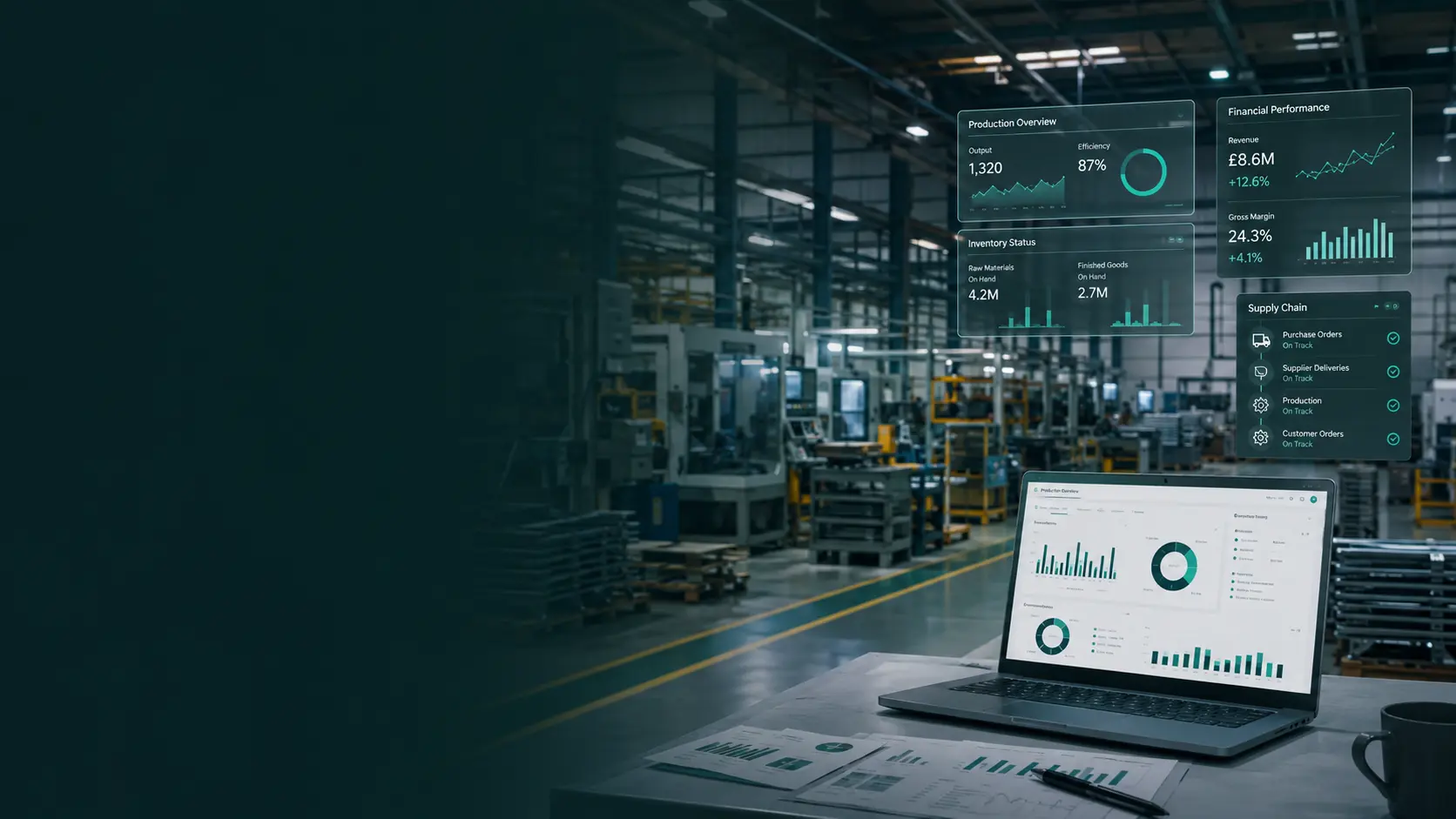
How growing manufacturers use NetSuite to improve production control, inventory visibility, and financial decision-making
Why Growing Manufacturers Outgrow Their Existing Systems
Most manufacturers don’t seek a new ERP system because current software stops functioning, problems typically accumulate gradually. Finance systems continue processing reports, invoices get handled, and month-end closes occur, yet behind the scenes, production planning happens in spreadsheets, work-in-progress tracking occurs manually, and stock levels don’t match reality. Different teams work from different versions of truth.
As complexity increases with more products, suppliers, production lines, customers, and data, systems that once supported the business become barriers. Eventually, organizations spend considerable effort working around systems rather than leveraging them for improvement.
This is where UK manufacturers typically explore ERP platforms like NetSuite. However, selecting an ERP isn’t simply about finding manufacturing features, the crucial question is whether the system will resolve operational challenges limiting growth.
The Common ERP Challenges Facing Growing Manufacturers
Production planning that relies on spreadsheets
Many manufacturers reach a point where manual production planning becomes unmanageable. While original spreadsheets worked initially, manufacturing complexity increases over time with new products, changing lead times, sourcing difficulties, and shifting customer priorities.
A core challenge: production information exists separately from the ERP system. Operations teams know factory floor reality while finance teams work from different data. When production changes, impacts on inventory, costs, and customer commitments aren’t immediately visible.
“NetSuite helps bring these areas together by connecting production, inventory, purchasing, and finance information in one system.”
Bills of materials that are difficult to maintain
A bill of materials (BOM) defines components, materials, and processes required to build finished products. Accurate BOMs enable effective production planning, cost calculation, and inventory management. Inaccurate BOMs cause:
- Incorrect material requirements
- Inaccurate product costs
- Stock discrepancies
- Purchasing mistakes
- Production delays
This becomes particularly challenging for manufacturers regularly updating products or managing multiple versions.
NetSuite allows managing single-level and multi-level BOMs with revision control, ensuring production teams work from correct information.
Limited visibility of work in progress
For many manufacturers, work-in-progress is where finance and operations disconnect. Production happens daily, but financial impact isn’t always visible until later, creating challenges around:
- Accurate product costing
- Inventory valuation
- Month-end reporting
- Understanding production performance
When work orders exist within NetSuite, production activity feeds directly into inventory and finance, giving finance teams clearer factory floor visibility without relying on manual updates.
Stock that does not reflect reality
Manufacturers manage more than finished goods, they need visibility of:
- Raw materials
- Components
- Subassemblies
- Work in progress
- Finished products
When stock movements aren’t captured accurately, systems drift from reality and teams rely on experience and manual checks rather than trusting data.
NetSuite helps maintain better inventory control by tracking materials through purchasing, production, and fulfillment. For traceability-critical industries, lot and serial tracking provides visibility from supplier receipt through customer delivery.
Cost information arriving too late
Manufacturers need understanding what products actually cost to produce. However, many only discover cost issues after production finishes and numbers are reviewed, missing efficiency improvement opportunities by then.
NetSuite supports standard costing, actual costing, and variance analysis, helping businesses compare expected costs against actual results. This gives management earlier visibility of material cost changes, production variances, labour costs, and margin pressure.
How NetSuite Helps Manufacturing Businesses
Managing Bills of Materials
NetSuite provides a central location for managing product structures, components, and revisions. This enables teams to:
- Maintain accurate BOMs
- Track product changes
- Manage subassemblies
- Improve production planning
- Support more accurate costing
For manufacturers with complex products or frequent engineering changes, controlled BOM data is essential.
Improving Production Control with Work Orders
Work orders connect customer demand, production activity, inventory, and finance, allowing manufacturers to:
- Plan production
- Allocate materials
- Record labour and machine time
- Track completion
- Capture production variances
For make-to-order manufacturers, work orders link directly to customer demand. For make-to-stock businesses, they provide better planned production control. The result is clearer connection between production, materials used, and costs.
Using MRP to Improve Purchasing Decisions
Material Requirements Planning (MRP) helps answer: “What do we need to buy or produce, and when?”
NetSuite MRP considers customer demand, forecast requirements, current stock levels, BOM requirements, and supplier lead times. It doesn’t replace experienced buyer judgment but provides better information and reduces manual monitoring needs.
Improving Manufacturing Inventory Management
Manufacturing inventory is more complex than standard stock management. Businesses need materials visibility throughout production.
NetSuite supports:
- Raw material tracking
- Component management
- Finished goods inventory
- Lot tracking
- Serial tracking
- Multi-location inventory
For manufacturers in food, electronics, medical devices, or aerospace industries, traceability can be critical.
Finance Automation Opportunities for Manufacturers
Many manufacturers invest in ERP systems yet maintain manual finance processes. This is where automation creates significant improvements.
Automating Accounts Payable
Manufacturers often process large supplier invoice volumes covering materials, components, subcontract services, and operating costs. Automation helps with:
- Invoice capture
- Approval workflows
- Purchase order matching
- Exception management
This reduces manual administration, allowing finance teams to focus on higher-value activities.
Improving Reconciliation and Month End
Month-end can be particularly challenging for manufacturing finance teams because operational activity creates large transaction volumes. MatchPoint, developed by Fowlers Consulting, automates reconciliation processes within NetSuite, improving visibility and reducing manual financial close effort.
For growing manufacturers, reducing repetitive reconciliation work helps finance teams close faster and spend more time analyzing performance.
Is NetSuite Right for Your Manufacturing Business?
NetSuite often fits manufacturers that:
- Have outgrown basic accounting systems
- Manage complex products or assemblies
- Need better production visibility
- Require stronger inventory control
- Want finance and operations connected
- Are expanding into new markets or locations
However, NetSuite isn’t automatically right for every manufacturer. A smaller manufacturer with simple production processes and limited complexity may find lighter solutions sufficient.
The important question isn’t “Does NetSuite have manufacturing features?” but rather “Will NetSuite solve problems preventing our business from scaling?”
What to Expect From a NetSuite Manufacturing Implementation
A typical NetSuite manufacturing implementation takes around four to six months, depending on:
- Product complexity
- Number of locations
- BOM quality
- Existing systems
- Required integrations
- Manufacturing processes
Most successful implementations start by understanding current business operations. Before configuration, manufacturers should understand:
- How production is planned
- How materials are consumed
- How costs are calculated
- How quality checks are managed
- How information flows between teams
Good preparation creates smoother implementation and better long-term results.
Final Thoughts
For growing manufacturers, ERP isn’t just a software decision, it’s creating a better operational way for the business.
“NetSuite can help manufacturers improve production control, increase inventory visibility, and connect finance with factory floor activity.”
The biggest benefits come when technology combines with clear process understanding and opportunities to remove unnecessary manual work. Fowlers Consulting helps UK manufacturers optimize NetSuite through implementation, optimization, and automation.
If teams spend more time managing spreadsheets than improving production, reviewing ERP capabilities may be timely.
Talk to the team about manufacturing requirements and discover how NetSuite could support your next growth stage.