
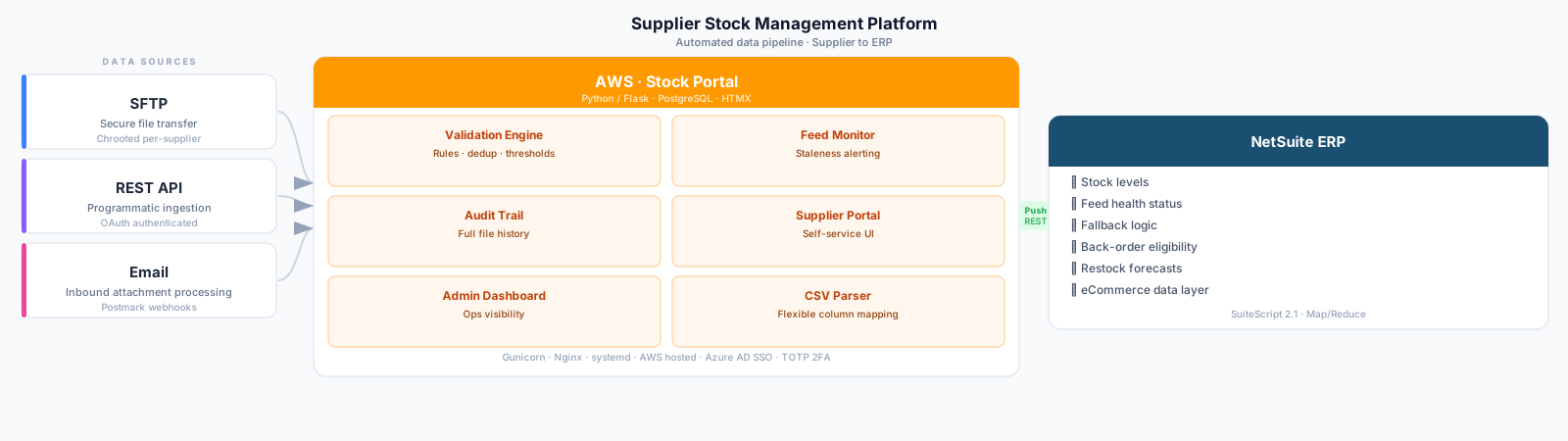
When supplier stock data arrives through email, spreadsheets, or not at all, eCommerce operations suffer real consequences. This article describes how Fowlers Consulting built an end-to-end solution for a business managing fifty+ dropship suppliers.
The Challenge
The business faced a fragmented data landscape. Stock information arrived through ad hoc emails, attached spreadsheets, and occasional one-off processes, each in different formats with varying column headers and update frequencies. The operational impact included oversells on unavailable products, missed sales opportunities, and significant manual processing overhead consuming staff time weekly.
The Solution
Meeting Suppliers Where They Are
Rather than forcing standardization, the platform accepts stock data through five channels: CSV uploads via browser portal, email attachments, SFTP, hosted URL polling, and REST APIs. Flexible CSV parsing accommodates the “full range of column headers, delimiters, and file encodings” without requiring supplier reformatting. Per-supplier validation rules detect anomalies like unexpected delivery windows or duplicate entries.
Visibility and Monitoring
A tiered staleness detection system monitors every supplier feed continuously, escalating alerts as feeds age past expected windows. The admin dashboard provides centralized visibility: last received/processed times, current status, and validation errors. Suppliers access their own portal to upload files, check item visibility, and track submission status.
Complete audit trails document every file received, validation run, and ERP sync, answering historical questions about data and stock levels.
NetSuite Integration
The integration layer treats stock data as multidimensional: quantities, feed health status, fulfillment type, restock forecasts, and back-order eligibility. Configurable per-supplier fallback logic addresses feed failures, either preserving last-known levels (accepting oversell risk) or zeroing stock (preventing oversells until recovery).
Back-order eligibility links to restock dates and feed health. Stock transition detection triggers downstream actions when products return to availability. Print-to-order and made-to-order items remain isolated from dropship logic.
Website Integration
NetSuite fields and Saved Searches expose clean signals to the eCommerce platform: availability status, back-order eligibility, expected restock dates, and purchasing rules. Logic centralizes in NetSuite rather than the website, enabling consistent governance across channels.
Outcomes
The business eliminated manual intervention under normal conditions. New supplier onboarding transitioned from requiring development work to a minutes-long operational configuration. Staff attention shifted from routine processing to exception-based operations, addressing only flagged problems.
Technology Stack
- Stock Portal: Python/Flask, PostgreSQL, HTMX server-rendered templates, AWS (Gunicorn, Nginx, systemd)
- ERP Integration: NetSuite REST API (OAuth 1.0), SuiteScript 2.1 Map/Reduce
- Email: Postmark inbound webhooks
- SFTP: Chrooted, per-supplier isolated access
- Authentication: Azure AD SSO for admins; bcrypt + TOTP 2FA for supplier accounts